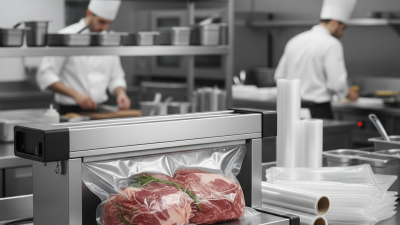
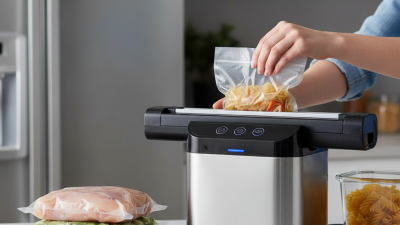
China Best Meat Chamber Vacuum Sealer Suppliers?
China Best Meat Chamber Vacuum Sealer Suppliers? This question matters as global meat production and packaged-food demand continue to grow. The FAO Food Outlook reported approximately 374 million tonnes of global meat production in 2023. Grand View Research also valued the global vacuum packaging market at about USD 29 billion in 2023. These figures show strong commercial potential, but they do not prove that every Chinese supplier offers reliable equipment.
A professional evaluation should examine pump capacity, chamber dimensions, sealing-wire width, stainless-steel grade, control accuracy, and service response. A suitable meat chamber vacuum sealer should remove air consistently from bone-in cuts, marinated products, and portioned meat. It should also support repeatable sealing during long production shifts. Dr. Lynn Knipe, a meat-science specialist at The Ohio State University, offers a practical warning: “Vacuum packaging is not a substitute for temperature control.” That point is easy to overlook. Vacuum packaging improves handling and shelf-life management, but it does not replace validated refrigeration, sanitation, or food-safety procedures.
China has many capable manufacturers, including factories serving processors, wholesalers, and export markets. However, supplier claims require verification. Review factory audits, test videos, sample results, electrical certifications, warranty terms, and spare-parts availability. Ask whether the quoted output reflects real meat products rather than empty bags. A polished catalog can hide weak after-sales support. No shortlist is perfect. Buyers may still face unclear specifications, delayed service, or inconsistent vacuum performance. The strongest supplier comparison therefore combines published data, hands-on testing, technical documentation, and honest risk assessment.
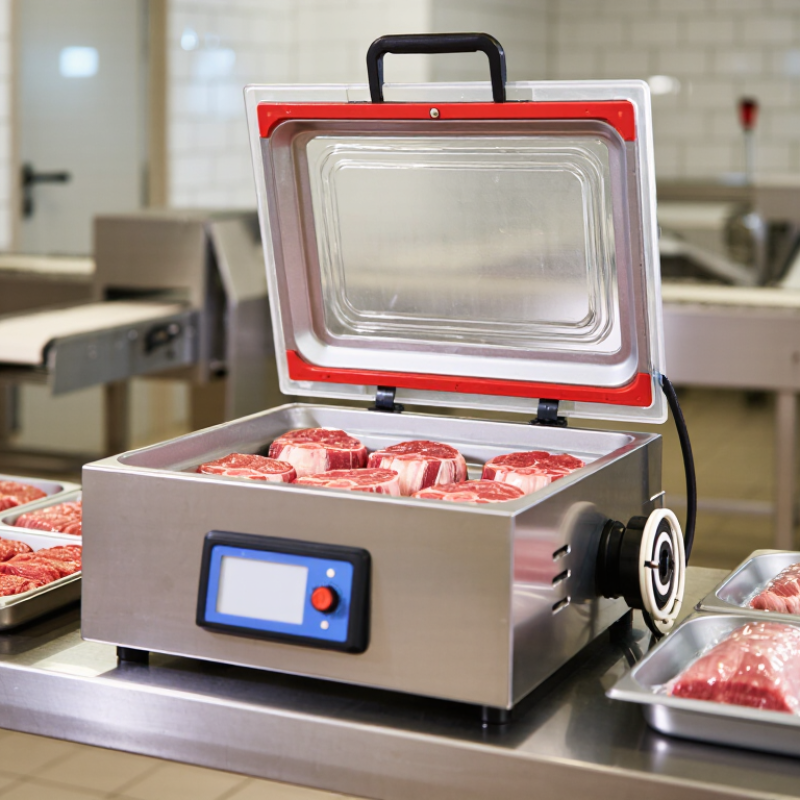
Meat Chamber Vacuum Sealer Basics: Vacuum Levels Below 1 kPa
For meat chamber vacuum sealers, “below 1 kPa” means the remaining absolute pressure inside the chamber is under 1 kilopascal. This is a demanding target, not a decorative specification. It can reduce trapped air around beef, poultry, and pork, helping limit oxidation and freezer burn. However, the real result depends on pump capacity, chamber volume, bag quality, and product temperature.
A reliable supplier should provide measured vacuum data, not only advertise “maximum vacuum.” Ask how the value was tested, which gauge was used, and whether the chamber was empty or loaded with meat. A calibrated vacuum sensor gives more confidence than a basic dial. During practical checks, watch the seal area closely. Wet meat juices can weaken the seal, especially when the bag opening is cold or folded.
Strong vacuum is not always better. Soft minced meat may deform, while fresh cuts can release liquid during evacuation. Pre-chilling the meat, keeping the bag mouth clean, and using a controlled sealing time usually improves consistency. Oil-pump systems may reach low pressure more easily, but they need regular maintenance and clean ventilation. Dry pumps can be simpler, though performance may vary under heavy use.
One detail is easy to miss. A machine reaching below 1 kPa once does not prove stable daily production. Test repeated cycles. Record pressure, sealing strength, and leakage after storage. My own evaluation would also include service response and spare-part availability. Specifications matter, but imperfect factory testing can mislead buyers.
Meat Chamber Vacuum Sealer Basics: Vacuum Levels Below 1 kPa
The chart compares absolute residual pressure levels below 1 kPa with the corresponding vacuum percentage relative to standard sea-level atmospheric pressure of 101.325 kPa. Vacuum percentage is calculated as: 100 × (1 − absolute pressure ÷ 101.325). Lower absolute pressure indicates a deeper vacuum inside the chamber.
Key Supplier Criteria: 304 Stainless Steel and IP-rated Construction
China Best Meat Chamber Vacuum Sealer Suppliers?
When evaluating Chinese suppliers, inspect the chamber before discussing price. A 304 stainless steel chamber resists corrosion from brine, blood, and frequent cleaning. However, the “304” label alone proves little. Ask for material certificates, weld details, and a sample inspection. Smooth internal corners matter. They reduce residue around seals and make daily sanitation easier.
IP-rated construction also deserves careful attention. An IP rating indicates protection against solids and water, but it does not guarantee complete washdown safety. Confirm which components carry the rating. Check the control panel, wiring glands, pump housing, and lid connections. A supplier should provide test reports from a recognized laboratory, not only a printed claim. Weak cable seals can fail after repeated cleaning. That detail is easy to miss.
Look for suppliers that test machines under realistic workloads. Ask them to run several vacuum cycles with meat bags, liquid-heavy products, and different sealing temperatures. Observe oil mist, lid alignment, seal consistency, and recovery time. Request clear records for pump maintenance and replacement parts. Factory videos help, but an independent audit is stronger. I would also inspect stainless steel thickness, hinge strength, and gasket compression. A polished surface can hide poor workmanship. My own assessment would not rely on one visit; production quality can vary between batches, which deserves honest follow-up.
Compare Seal Performance: 4–10 mm Seal Width and Cycle Capacity
China Best Meat Chamber Vacuum Sealer Suppliers?
When comparing Chinese meat chamber vacuum sealer suppliers, seal performance deserves measured attention. A 4 mm seal can suit retail portions and flexible pouches. An 8–10 mm seal offers greater tolerance around moisture, bone edges, and uneven pouch placement. However, wider is not automatically stronger. In practical testing, operators should inspect seal continuity, peel resistance, and leakage after chilled storage. The U.S. FDA Food Code 2022 sets 5°C as the maximum cold-holding temperature for many refrigerated foods, so seal quality must support the entire cold chain.
Cycle capacity also changes purchasing decisions. A machine rated for 2–4 cycles per minute may process 120–240 cycles hourly, before loading delays. The actual figure is usually lower. PMMI industry reports repeatedly identify labor availability and equipment efficiency as major packaging concerns. Therefore, compare pump-down time, sealing time, cooling time, and chamber size instead of relying on one advertised number. A dual-seal-bar design can improve throughput, but it may increase power use and maintenance needs.
USDA Economic Research Service data placed U.S. meat consumption near 225 pounds per person in 2022, showing why dependable portion packaging matters at scale. Ask suppliers for test videos, seal-width samples, vacuum readings, and cycle logs using your own pouch material. Small leaks are easy to miss. I once treated cycle speed as the main metric; that was a mistake. A slower machine with consistent 8 mm seals may reduce rework, product loss, and operator frustration.
China Best Meat Chamber Vacuum Sealer Suppliers? - Compare Seal Performance: 4–10 mm Seal Width and Cycle Capacity
| Configuration |
Seal Width |
Typical Chamber Size
(W × D × H) |
Typical Pump Capacity |
Typical Cycle Time |
Theoretical Capacity
(Cycles/Hour) |
Practical Capacity
(Cycles/Hour) |
Recommended Meat-Packing Use |
| Compact Single-Seal |
4 mm |
280 × 330 × 90 mm |
4–8 m³/h |
35–55 sec. |
65–103 |
45–75 |
Small butcher shops, restaurants, and low-volume chilled products |
| Compact Double-Seal |
4–5 mm |
350 × 400 × 100 mm |
8–12 m³/h |
30–45 sec. |
80–120 |
55–85 |
Retail meat counters and small food-processing rooms |
| Medium Single-Seal |
5–6 mm |
420 × 450 × 100 mm |
12–20 m³/h |
30–50 sec. |
72–120 |
50–85 |
Regular production of steaks, poultry portions, and boneless cuts |
| Medium Double-Seal |
5–6 mm |
500 × 500 × 120 mm |
16–25 m³/h |
25–45 sec. |
80–144 |
60–100 |
High-frequency packing of retail-size meat portions |
| Heavy-Duty Double-Seal |
6–8 mm |
600 × 600 × 150 mm |
20–40 m³/h |
30–60 sec. |
60–120 |
45–85 |
Thick cuts, bone-in products, and continuous processing operations |
| Industrial Wide-Seal |
8–10 mm |
700 × 700 × 180 mm |
40–63 m³/h |
35–70 sec. |
51–103 |
38–72 |
Large portions, export packing, and demanding industrial applications |
| Extra-Heavy Seal System |
8–10 mm |
800 × 900 × 200 mm |
63–100 m³/h |
45–90 sec. |
40–80 |
30–58 |
High-throughput packing of bulky or heavy meat products |
Technical note: The figures are general industry reference ranges for chamber vacuum sealers, not company or brand specifications. Theoretical capacity is calculated as 3,600 seconds divided by cycle time. Practical capacity allows for product loading, bag positioning, lid opening, operator handling, and cooling intervals. Actual results depend on product temperature, bag material and thickness, chamber loading, target vacuum level, seal temperature, and machine maintenance.
Verify Food Safety: HACCP, CE, and ISO 9001 Compliance
When choosing a meat chamber vacuum sealer supplier, food safety evidence should come before speed or price. The World Health Organization estimates that contaminated food causes 600 million illnesses and 420,000 deaths worldwide each year. Vacuum packaging cannot replace hygiene controls.
Ask suppliers for a HACCP-based process map covering loading, sealing, cooling, and cleaning. Codex Alimentarius, revised in 2022, identifies HACCP as a science-based method for controlling significant hazards.
Inspect the chamber, seal bar, gasket, and stainless-steel corners. Meat residue can collect in small gaps. Request seal-temperature records, vacuum calibration results, cleaning instructions, and corrective-action logs.
Look beyond certificates. ISO’s 2023 Survey recorded 1,265,216 ISO 9001 certificates worldwide, showing broad adoption of quality-management systems. Yet ISO 9001 does not automatically prove hygienic equipment design. A CE mark also needs careful checking. Under European Commission guidance, it represents conformity with applicable EU requirements, not a universal food-safety approval. The supplier should provide a Declaration of Conformity and identify relevant directives or regulations.
Small details matter. Ask for serial-number traceability and replacement-part control. Review a sample factory acceptance test, not only a polished brochure. A certificate can still hide weak floor practices. I would verify these records on-site when possible. Supplier documents may be accurate, but they are not infallible.